Not every IPTV service is created equal for American audiences. A provider that works brilliantly for viewers in the UK or Europe may miss everything that matters to someone watching in the US — no local network affiliates, no regional sports coverage, and no familiarity with the content landscape American viewers actually care about. When you are specifically looking for the best IPTV service in the USA, the evaluation criteria shift considerably from a generic global search.
This article drills into exactly what US viewers should prioritize when comparing IPTV subscriptions — and what separates a service genuinely suited to American viewing habits from one that merely claims to cover the US market. For the broader framework on evaluating any IPTV provider, see our complete IPTV provider guide.
What Makes an IPTV Service the Best for the USA Specifically
The US television market is unique in several ways that directly affect what an IPTV subscription needs to deliver. Unlike many countries with a handful of dominant national broadcasters, the American TV landscape is a complex mix of national broadcast networks, hundreds of local affiliate stations, regional sports networks tied to specific markets, and premium cable channels that vary in rights availability across state lines.
This complexity means that a US-focused IPTV service has to navigate a much more demanding content licensing environment than services targeting simpler broadcast markets. The best services for American viewers invest in this complexity — they carry genuine local feeds, maintain regional sports coverage, and build their infrastructure to handle the peak demand that US prime time and major sporting events create.
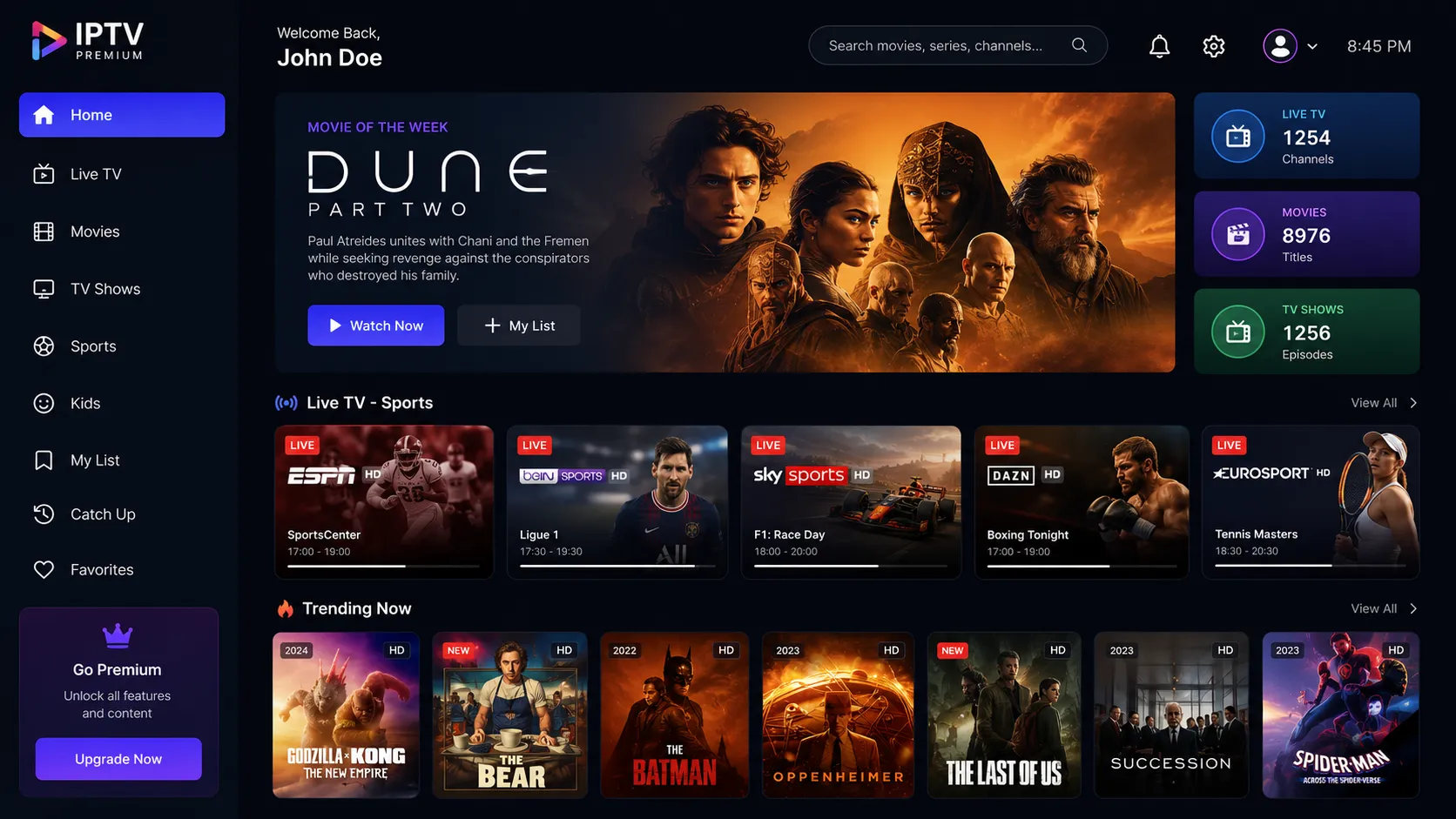
The USA-Specific Channels That Separate Good Services from Great Ones
When US viewers evaluate IPTV services, a few channel categories consistently matter most and are the areas where providers most frequently disappoint.
Local network affiliates. The national feeds of ABC, NBC, CBS, FOX, and PBS are commonly included in IPTV packages, but the real test is whether a provider carries your specific local affiliate. Local news, local weather, and local sports are broadcast on your regional affiliate — not the national feed. Many providers carry only national feeds, which means you miss local content. Before subscribing, ask explicitly whether your city's ABC, NBC, CBS, or FOX station is available in your specific market, not just the national version.
Regional sports networks. American sports fandom is intensely regional. Whether your priority is watching the local NBA team on Bally Sports, following an MLB franchise on a regional sports network, or tracking an NHL team on a regional cable outlet, the best US IPTV service for your household is one that carries the regional sports network serving your market. This is perhaps the single hardest content category to find consistently in IPTV subscriptions, because regional sports rights are fragmented and expensive. Verify RSN availability explicitly during a free trial — don't assume it based on a general "sports channels included" claim.
National sports packages. Beyond regional coverage, US viewers often prioritize national sports broadcasting: NFL games on ESPN, Sunday Night Football on NBC, Thursday Night Football on Amazon Prime's broadcast, NBA playoffs on TNT and ABC, and college football across ESPN and ABC. A quality US-focused IPTV service carries these broadcast and cable sports channels with consistent stream stability — not just on weeknights when servers are lightly loaded, but during the major games that draw peak concurrent viewership.
US news networks. American news consumption is distributed across CNN, Fox News, MSNBC, CNBC, and C-SPAN, along with local news on affiliate channels. A service that claims broad US coverage but has unstable or frequently down streams on these high-profile channels is not genuinely optimized for the American market.
Device Compatibility for US Viewers
US viewers overwhelmingly use a handful of devices for IPTV streaming. Amazon Fire TV Stick — particularly the 4K Max model — is the most popular IPTV device in the US market by a significant margin. A service that delivers a great experience on Fire TV Stick is well-positioned for American households. Android TV boxes are the second most common device category, followed by Smart TVs from Samsung and LG, Apple TV, and smartphones or tablets.
The best US IPTV subscription delivers a playlist URL that works reliably with the major player apps available on these devices — TiviMate, IPTV Smarters Pro, and GSE Smart IPTV cover the vast majority of US viewer device situations. If a provider only supports their own proprietary app, or if their M3U URL doesn't work with the player you have already installed, that is a compatibility problem worth discovering during a trial before paying. Our IPTV player apps guide compares the major options by device.
Internet Requirements for US IPTV Streaming
The United States has broad broadband access, and most US households with IPTV subscriptions have sufficient download speeds for HD or Full HD streaming. However, connection stability — not just raw speed — is what determines day-to-day streaming quality. A 100 Mbps cable connection that fluctuates significantly during evening peak hours can cause more IPTV buffering than a consistent 30 Mbps fiber connection.
For single-stream HD IPTV, 15–25 Mbps of stable throughput is sufficient. 4K streams require 50 Mbps or more. Multi-device households with two or three simultaneous streams need to multiply accordingly. A wired Ethernet connection from your streaming device to your router is the single highest-impact improvement most US IPTV users can make — more impactful than upgrading to a faster tier with the same Wi-Fi setup.
Pricing Expectations for US IPTV Subscriptions in 2026
The US IPTV market has developed enough that reasonable pricing benchmarks exist. Services priced at implausibly low rates for what they claim to offer — comprehensive US local coverage, regional sports, 4K streams, and multi-device support — are often cutting corners on infrastructure, content acquisition, or both. The corners cut typically show up as degraded stream quality during peak hours, EPG inaccuracies, and sluggish or absent customer support.
Starting with a monthly subscription rather than committing to a longer billing cycle is the right approach for any IPTV service you haven't tested over at least one full month of use. A trial period tells you how the service performs during setup, but a full billing cycle tells you how it performs during major US sporting events, season premieres, and other high-demand periods. Our IPTV free trial guide walks through what to evaluate during the trial period before committing financially.
Common Mistakes US Viewers Make When Choosing IPTV
The most expensive mistake is paying for a long-term subscription — quarterly or annual — before verifying that the service delivers your specific must-have channels. The second most common mistake is relying on channel count claims rather than testing actual coverage. A provider advertising "10,000 US channels" who doesn't carry your local Fox affiliate or your regional sports network is not useful to you, regardless of the total number.
A third common mistake is not testing the service during peak hours. Many IPTV services perform acceptably during off-peak testing — weekday mornings, for example — but degrade noticeably during Sunday afternoon NFL games or Monday Night Football, when US server load peaks. Always test during the times you actually intend to watch.
Find the Right US IPTV Service for Your Household
Tell us which channels and devices matter most — we'll help you identify services worth testing and point you toward a trial before any financial commitment.
Frequently Asked Questions — Best IPTV for USA Viewers
The best IPTV service for US viewers is one that carries your local network affiliates for your specific market, the regional sports networks covering your preferred teams, consistent HD and 4K stream quality during peak US viewing hours, and responsive customer support. There is no single best service for every American viewer — the right choice depends on which channels matter most to your household, which devices you own, and how many simultaneous streams you need. Testing with a free trial before paying is always the recommended approach.
Some IPTV services include local US network affiliates, but coverage varies significantly by provider and by market. National feeds of ABC, NBC, CBS, and FOX are more commonly included than true local market feeds. Always ask whether your specific city's local affiliate — not just the national network — is available before subscribing. A free trial is the best way to verify this for your market before making any financial commitment.
Pricing varies by provider, plan tier, and simultaneous connection count. Services priced implausibly low relative to what they claim to offer are worth approaching with caution — the corners cut usually show up in stream quality, EPG accuracy, and support responsiveness. Starting with a monthly plan rather than a long-term commitment gives you flexibility to evaluate the service over a full billing cycle before investing in a longer subscription.